
The California Digital Humanities Research Institute (CaliDHRI) will take place April 27-29th, 2022.
CaliDHRI is a free, annual digital ethnic studies institute inspired and co-sponsored by CUNY DHRI as well as UC Irvine Libraries and UCLA Libraries. The inaugural CaliDHRI will center Black digital humanities thematically while focusing on California-centric research questions and datasets.
Our 2022 theme, “The Black Press”, will be explored by three keynote speakers who will highlight their own Black digital humanities research and projects.
All CaliDHRI keynotes are free and open to the public. Those who register will receive a recording after the event. Register via Zoom here: https://ucla.zoom.us/webinar/register/WN_lwu0I0JuTVOyLy72ICLl3g
Interested in applying for the Institute? Learn more here: https://bit.ly/calidhri2022
April 27 Keynote: “Finding Elizabeth Mitchell: Tracing the History of Early Black Atlantic Filmmaking” by Dr. Ellen Scott

Dr. Ellen Scott is Associate Professor and Associate Dean at the School of Theater, Film, and Television, UCLA. She is the author of Cinema Civil Rights: Race Repression and Race in the Classical Hollywood Era (Rutgers, 2015) and is working on two books: Cinema’s Peculiar Institution, a history of the representation of slavery on screen, and Bitter Ironies, Tender Hopes, which explores Black women’s film criticism from the dawn of cinema until the first Black woman made a feature film in 1980.
April 28 Keynote: “Digitizing Memory: The Black Panther Oakland Community School Yearbook Project” by Angela LeBlanc-Ernest
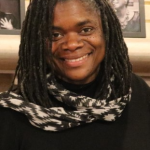
Angela LeBlanc-Ernest’s work focuses on American History post-1965, with an emphasis on the Modern Black Freedom Struggle. She is a graduate of Harvard University with a BA in Afro-American Studies and graduated from Stanford University with an MA in American History. The founding director of the Black Panther Party (BPP) Research Project at Stanford, her work on the BPP’s history includes the study of women, the impact of gender in the Party, and the organization’s community Survival Programs. She has published peer-reviewed articles and book chapters as well as public facing articles and digital projects. Her publications have appeared in anthologies, academic journals, blogs and encyclopedias as well as popular venues such as Colorlines, Vibe and the Black Youth Project.
LeBlanc-Ernest is the director of The OCS Project LLC, created to recover and preserve the Black Panther Party’s Oakland Community School history and foster curriculum-based projects and community-based conversations about the BPP’s Oakland Community School. She also is a co-founder of the Intersectional Black Panther Party History Project (IPHP), a collective of four historians and filmmakers committed to the recovery and restoration of the BPP’s history and women’s critical roles in the organization. Currently, she is producing and directing a documentary film about the BPP’s Oakland Community School, one of the Party’s longest-lasting community Survival Programs and a community partner with and co-leader of The Black Panther Oakland Community School: Community Archives, Activism, and Storytelling Research Cluster at the University of California at Irvine.
April 29 Keynote: “Pleasure and Politics: The Evolving Role and Meaning of the Black Press in the Technological Age” by Dr. Kim Gallon
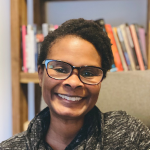
Dr. Kim Gallon is an Associate Professor of History at Purdue University. Her work investigates the cultural dimensions of the Black Press in the early 20th century and the history of technology, race, and health equity. She is the author of a number of articles and essays as well as the book, Pleasure in the News: African American Readership and Sexuality in the Black Press (University of Illinois Press, 2020). Gallon is also the author of the field defining article, “Making a Case for the Black Digital Humanities” and the founder and director of two black digital humanities projects: The Black Press Research Collective and COVID Black.